Wool, textiles, and the science of sleep
How Quilting and Fill Weight Shape a Natural Comforter
A comforter’s warmth is not determined by fiber alone. The pattern of its stitching, the amount of filling inside, and whether its layers can be separated all influence how it feels on a bed—and how it performs as temperatures change.
Published November 9, 2026
Lift the edge of a comforter and its quiet engineering comes into view. Inside the fabric shell, a layer of fiber is held in place by seams, stitches, or small knots. Those details may seem modest beside the softness of the cloth or the weight of the blanket, but they help determine whether filling stays evenly distributed, whether the comforter drapes smoothly, and how much insulation it provides across the bed.
Natural-fiber comforters make these design choices especially visible. Wool has a springy structure that can trap air, compress under pressure, and recover when released. Yet wool’s inherent properties are only part of the story. A tightly quilted comforter, a hand-tufted one, and a two-layer design may all contain wool but behave differently in use. Understanding how quilting and fill weight work together makes it easier to choose bedding that suits a room, a season, and the sleeper beneath it.
The hidden architecture inside a comforter
A comforter is more than a shell filled with insulating material. It is a textile structure: an outer fabric encloses a layer or layers of batting, and a method of construction keeps that filling from migrating. Cotton is commonly used for the shell of natural wool comforters because it is a familiar, woven fabric that can be stitched to the filling. The wool itself may be arranged as a continuous batting or in another prepared form, depending on the product.
Without some means of restraint, filling can shift as a comforter is folded, pulled, or slept under. Over time, movement may leave thin areas and thicker pockets. Stitching divides the surface into sections or anchors the batting at intervals, helping it remain more consistently spread. The result is not necessarily a perfectly uniform temperature everywhere—bodies, room conditions, and bedding layers all affect warmth—but secure construction helps a comforter retain its intended shape.
Construction also changes how a comforter bends and settles. A stitch line can act like a hinge, allowing the fabric to fold more readily at that point. A closely segmented pattern may keep filling controlled in smaller areas, while a design with fewer stitch lines can leave broader expanses of uninterrupted loft. Neither approach is automatically best. The useful question is how the construction balances stability, loft, flexibility, and care.
Quilting: keeping the filling in place
Quilting joins layers of textile with repeated lines of stitching. On a comforter, those seams may create squares, channels, diamonds, or another repeated arrangement. The pattern gives the filling regular anchor points and helps limit its movement within the cover. A quilted design can also shape the comforter’s surface, creating a visible grid or rhythm across the bed.
Each stitched line compresses the layers slightly where needle and thread pass through them. That narrow seam contains less loft than the broader areas between seams, so quilting involves a practical trade-off: more frequent anchors can help control the filling, while larger open areas allow more uninterrupted loft. The scale and spacing of the pattern matter, as does the thickness of the batting and the way the comforter is intended to be used.
On wool bedding, quilting can help the batting stay spread through regular use. Some designs use a shell stitched to the filling, creating a network of secure points. A comforter described as quilted should still be assessed as a complete construction: look at the pattern, the fill, the fabric, and the care instructions rather than treating the word “quilted” as a guarantee of one particular level of warmth or durability.
Hand-tufting and perimeter stitching
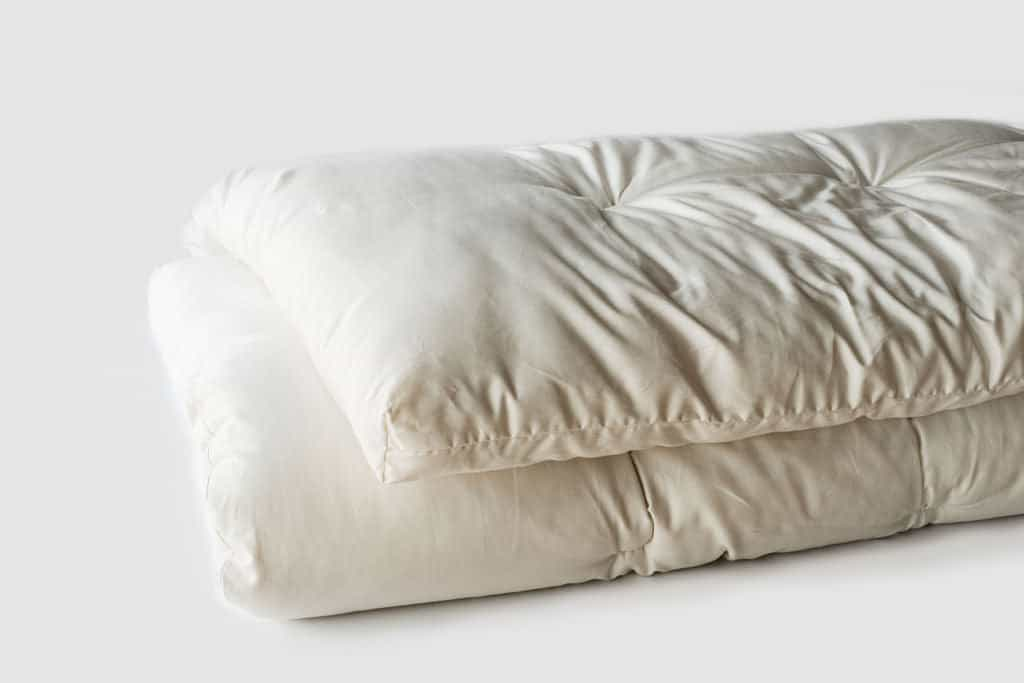
Hand-tufting is another way to hold filling in place. Instead of forming a continuous grid of machine-sewn compartments, a maker anchors the layers at spaced points, often with thread or fabric ties passed through the comforter. Perimeter stitching secures the edges. Together, these details can help keep batting from bunching or drifting toward the sides while leaving larger areas between anchors.
Tufted construction is not the same as loose or unstructured filling. The ties provide points of restraint, while the edge stitching helps define the comforter’s shape. The spacing between tufts, the amount of wool, and the firmness of the batting all influence how the finished piece feels. As with quilting, there is no single construction that suits every sleeper. Some people prefer a smoother, more controlled surface; others value a softer drape and generous loft.
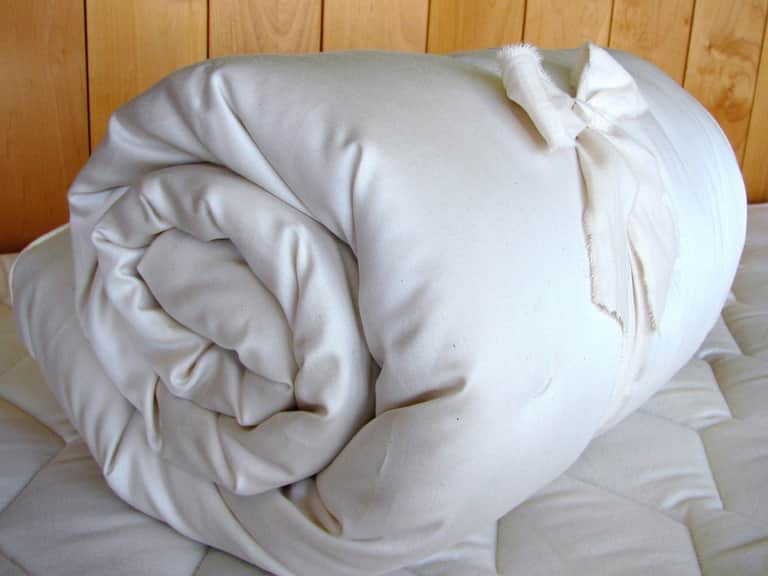
Wool comforters with hand-tufted construction may call for gentler care than products designed and labeled as machine washable. A maker’s instructions take precedence over assumptions based on fiber type. For example, the All-Natural Wool Comforter is described as handcrafted with domestically sourced wool batting and an organic cotton sateen shell, with corner ties for use inside a duvet cover. Its care guidance specifies spot cleaning and, if necessary, cold-water soak-and-spin handling rather than a regular wash cycle. That distinction illustrates a broader point: construction and care are linked, and “natural” does not automatically mean “easy to wash.”
Fill weight and the meaning of warmth
Fill weight refers to the amount of filling used in a comforter, though the way it is stated can vary. A product may describe the wool weight for a particular size, the weight per unit of area, or simply offer light, medium, and heavier options. These measures are not always directly comparable across brands. Dimensions, fiber blend, batting structure, and shell construction can all affect the finished feel.
In general, more filling can provide greater loft and insulation, but fill weight alone is not a complete warmth rating. Fiber type and preparation influence how air is held within the filling. The comforter’s size and quilting pattern affect how that filling is distributed. The cover, duvet cover, mattress, room temperature, and other blankets add further layers to the sleep environment. A heavier comforter may feel warmer or more substantial to one person, while another sleeper may prefer a lighter, more breathable layer.
Wool’s crimped fibers can help create spaces that hold still air, which contributes to insulation. Wool also absorbs moisture vapor, so a wool-filled comforter may feel different from a layer that relies solely on a smooth, dense surface for warmth. These are material characteristics, not promises that every sleeper will stay at an ideal temperature. Individual comfort varies, and bedding works as part of a larger microclimate between body, fabric, and room.
When comparing natural comforters, check exactly what the listed weight means. If one item gives a fill weight for a twin size and another gives a per-area figure, those numbers cannot be compared without more information. Where choices are offered by fill level, consider the typical climate and whether the bedroom is heated, as well as personal preferences for a light covering or a more enveloping layer.
Single-layer, dual-weight, and all-season designs
A single-layer comforter is the simplest arrangement: one filled piece provides the chosen level of warmth. Its appeal is straightforwardness. There is no need to attach separate sections or decide how to configure layers, although the user must select a fill weight that works for most of the conditions in which it will be used. A lighter option can suit warmer rooms or people who prefer less insulation; a heavier one may be more comfortable in a cool bedroom.
A dual-weight design addresses differences across a bed rather than across the calendar. It may place different amounts of filling in separate sections, allowing partners with contrasting temperature preferences to share one comforter. The arrangement can be practical, but it depends on the layout of the bed and on where each person sleeps. It is worth checking how the sections are positioned and whether the division aligns with the way the comforter will be used.
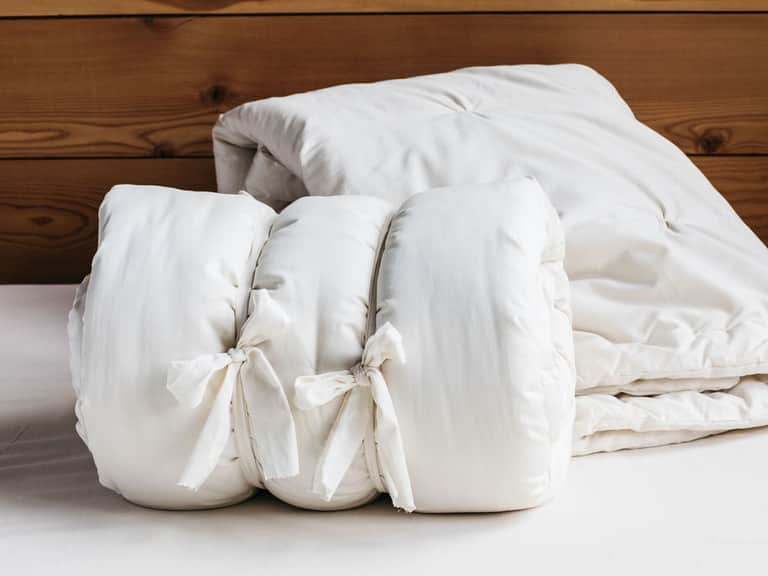
All-season designs often use two layers that can be connected for colder periods and separated when the weather is milder. Ties or other fasteners may join the sections, allowing one layer to serve on its own and the combined set to provide additional insulation. This flexibility can reduce the need to store several unrelated comforters, though the joined version will be heavier and requires a little more handling when changing configurations.
The All-Natural Wool Comforter offers a choice of three fill weights, allowing shoppers to select among different amounts of wool within a broadly similar construction. For a separate example of a layered approach, an All-Season Wool Comforter is described as two quilted layers joined with cotton ties, so they can be used together or separately. The details of any model should be checked before purchase: “all-season” describes an intended range of use, not a guarantee that one configuration will suit every climate or sleeper.
Seasonal versatility is about more than the calendar
People often think of a comforter as a winter object or a summer object. In practice, the relevant conditions can change from night to night. A room’s insulation, heating or cooling, open windows, local humidity, and the sleeper’s own temperature preference all shape the experience. In a cool home, a medium-weight comforter may remain useful for much of the year. In a warm bedroom, even a lighter option may feel excessive on some nights.
Layered designs allow users to respond to those changes. A detachable second layer can be stored when not needed, while a duvet cover offers a removable textile barrier that can be laundered according to its own instructions. The cover can also influence the feel of the bedding against the skin. However, adding layers changes the total insulation, so seasonal adjustment is not simply a matter of following a month on the calendar; it is a matter of responding to the room and the sleeper.
Fill weight gives a useful starting point, while the ability to separate layers offers another kind of control. A single comforter with a carefully selected weight may be the better choice for someone who values simplicity. A two-part design may suit households where temperatures vary substantially or where bedding needs change through the year. The most versatile option is not necessarily the one with the most components; it is the one whose adjustments are practical enough to use.
Care follows the construction
Comforter care is not one-size-fits-all. Some wool-filled products are made to tolerate machine washing under specific conditions; others are intended for spot cleaning, occasional airing, or careful professional cleaning. Washing wool aggressively, using unsuitable temperatures, or applying too much agitation may cause fibers to mat or felt. Excess heat and incorrect drying can also affect the filling and shell.
Before buying, consider where the comforter will be used and how it is likely to be maintained. A guest-room comforter may be used less often than a family bed’s everyday layer. A duvet cover can help protect the shell from routine contact, but it does not remove the need to follow the comforter’s care directions. If the instructions specify a cold soak-and-spin cycle, that is not equivalent to a standard wash cycle. If they say not to machine dry, a low dryer setting is still not appropriate.
Construction can affect care as well. Stitching and quilting help stabilize filling, but the shell and batting still need suitable handling. Tufts and ties should be checked for damage during routine inspection. If the comforter can be separated into layers, confirm whether both pieces have the same cleaning requirements. When in doubt, follow the label or the manufacturer’s detailed instructions rather than relying on general advice for wool garments.
A practical checklist before choosing
Descriptions can make natural comforters sound similar, even when their design differs in meaningful ways. A few focused questions help move from broad claims to useful comparisons:
- What does the fill-weight description measure? Check whether it refers to a named weight option, a particular size, or a quantity per area.
- How is the filling held in place? Look for details such as quilted sections, hand-tufting, perimeter stitching, or a combination.
- Can the warmth be adjusted? Find out whether the design is a single layer, a dual-weight arrangement, or a pair of detachable layers.
- What does the care label actually allow? Distinguish machine-washable products from those that require spot cleaning or limited washing methods.
- What are the shell and fill made of? Fiber blends and fabric construction can influence feel and maintenance.
- How will it fit the bed and duvet cover? Confirm dimensions, corner ties or loops, and compatibility with the cover you intend to use.
- What conditions matter most? Consider the bedroom’s temperature, personal warmth preferences, and whether other layers are already part of the bed.
Reading the stitches, choosing the layer
The surface of a comforter may look quiet, but its seams record decisions about movement, warmth, and care. Quilting creates a network of anchors. Hand-tufting secures the filling at selected points. Perimeter stitching helps finish and stabilize the edge. Fill weight influences how much fiber is present, while layered designs make that insulation adjustable. Each choice changes the relationship between loft and control.
For a natural wool comforter, the best starting point is not a broad claim that one material is universally cooler, warmer, or easier to maintain. It is a close reading of the construction and the instructions. Compare equivalent measurements where possible. Decide whether a single fill weight or separable layers suit the way the room changes through the year. Then account for the practical work of protecting and caring for the bedding.
In the end, comfort is built from small decisions repeated across a bed: the spacing of a stitch, the depth of a layer, the texture of a shell, and the air held between fibers. Choose with those details in mind, and the comforter becomes more than a warm cover. It becomes a carefully constructed part of the sleep environment—one that can be matched to the household’s habits, preferences, and changing nights.